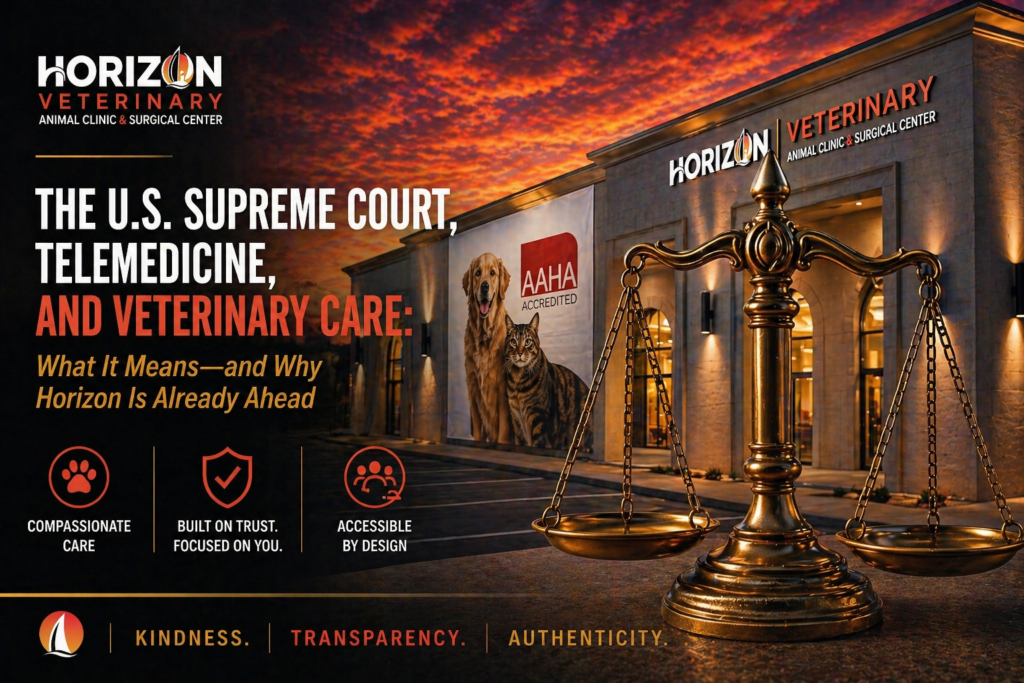
The U.S. Supreme Court, Telemedicine, and Veterinary Care: What It Means—and Why Horizon Is Already Ahead
Recent activity from the Supreme Court of the United States is bringing new attention to veterinary telemedicine and the Supreme Court’s influence on how professional communication may be regulated in the future.
Key Takeways
- No immediate changes to the law
Veterinary telemedicine rules in Texas remain unchanged. A valid Veterinary Client Patient Relationship is still required before diagnosis, treatment, or prescribing can occur. - A meaningful legal shift is underway
Recent activity from the Supreme Court of the United States reinforces protections around professional communication, which may influence how telemedicine regulations evolve over time. - Access to guidance will expand
Expectations around speed, clarity, and availability of veterinary guidance are increasing. - The real shift is not access alone—it is accountability
The future will favor systems that do not just provide answers, but guide decisions and deliver care within the same structure. - Horizon was built for this environment
The Accessible Care Model aligns communication, clinical care, and financial pathways into a single system.
What actually happened
The American Veterinary Medical Association recently highlighted activity from the Supreme Court of the United States that, while not directly addressing veterinary medicine, has implications for how professional advice may be regulated.
The Court did not issue a ruling on veterinary telemedicine.
Instead, it reinforced a broader principle:
Professional communication, including general advice and guidance, carries constitutional protection.
This matters because telemedicine is fundamentally communication-driven.
Veterinary medicine, however, operates within established legal frameworks, including the Veterinary Client Patient Relationship, or VCPR.
In Texas:
- A physical examination is required to establish a VCPR
- Telemedicine is permitted only after that relationship exists
Horizon Veterinary operates fully within all current Texas laws and regulations. No diagnosis, treatment, or prescribing occurs without a valid and legally established VCPR. All clinical decisions are made on a case-by-case basis using appropriate medical judgment.
Why this still matters
Even without immediate regulatory change, the legal environment is shifting.
Courts are increasingly evaluating:
- how professional communication is restricted
- whether those restrictions are justified
This does not eliminate existing laws.
But it introduces pressure on how those laws are interpreted over time.
The real shift: expectation
While regulation evolves gradually, client expectations do not.
Pet owners increasingly expect:
- immediate access to guidance
- clarity in decision-making
- reduced uncertainty
The gap between expectation and traditional delivery models is where access breaks down.
This is why veterinary telemedicine Supreme Court discussions are becoming increasingly relevant to how care will be delivered.
What the veterinary telemedicine Supreme Court shift really means
Two likely paths:
Gradual evolution
- Expansion of tele-triage and general guidance
- Increased flexibility in communication
- Continued reliance on physical exams for diagnosis and treatment
Accelerated transformation
- Greater acceptance of remote interaction
- Increased platform-driven access
- Higher expectations for responsiveness
In both cases:
Access to guidance becomes faster.
But guidance alone does not replace clinical care.
Why Horizon’s Accessible Care Model Is Leading the Way Nationally
Horizon Veterinary did not build around telemedicine.
We built around decision-making.
Horizon Veterinary originated the Accessible Care Model (ACM)—both the name and the operational framework.
Accessible Care Model (ACM): A system that connects guidance, clinical care, and financial pathways so pet owners can make informed decisions and act on them appropriately within an established veterinary relationship.
The problem is not just lack of access.
It is:
uncertainty between concern and action.
The ACM System
Real time guidance | ER versus wait support | Horizon Guardian™ structured triage system | Link™ Specialty Consultation Network | Open concept care | Direct access to the veterinarian | Integrated diagnostics and treatment | Structured follow-up | Transparent pricing with multiple pathways to care
These components are designed to:
- support decision-making
- provide structured triage and general guidance
- facilitate timely in-clinic evaluation when indicated
They are not a substitute for a physical examination or comprehensive veterinary assessment when required.
Learn more about how we deliver care at Horizon Veterinary.
Specialty access without unnecessary delay
A key component of the system is the Link™ Specialty Consultation Network, which enables real-time specialist collaboration within an established Veterinary Client Patient Relationship, allowing Horizon to streamline traditional referral workflows and reduce delays in obtaining specialty input.
This approach improves efficiency and access to specialty perspectives while maintaining all required examinations, diagnostic standards, and professional oversight.
Financial access is clinical access
Access fails when care cannot be acted on.
Horizon supports this through:
- CareCredit and Scratchpay
- Repay
- Pet insurance integration with guidance
These financial tools are offered to improve access and reduce delays.
All diagnostic and treatment recommendations remain based solely on medical appropriateness and professional standards, independent of payment method.
What this means for pet owners
You are not left with:
- information alone
- or fragmented next steps
You receive:
- guidance
- direction
- continuity
within a system designed to connect communication with appropriate in-person care when needed.
If you need guidance, you can request an appointment directly through our scheduling page.
The bottom line
The legal environment is evolving. As veterinary telemedicine Supreme Court implications continue to develop, systems that align guidance with care will lead the industry.
Expectations are evolving faster.
The future of veterinary care will not be defined by access alone.
It will be defined by:
who guides decisions—and stands behind them.
Horizon is already operating inside that future—within current regulations and with a system designed to evolve responsibly as those regulations change.